Artificial Intelligence is already a big part of our lives. From using Google Maps for directions to browsing our favourite eCommerce sites to getting suggestions for what movies to watch to unlocking our smartphone with facial recognition, AI is helping us in many of these activities.
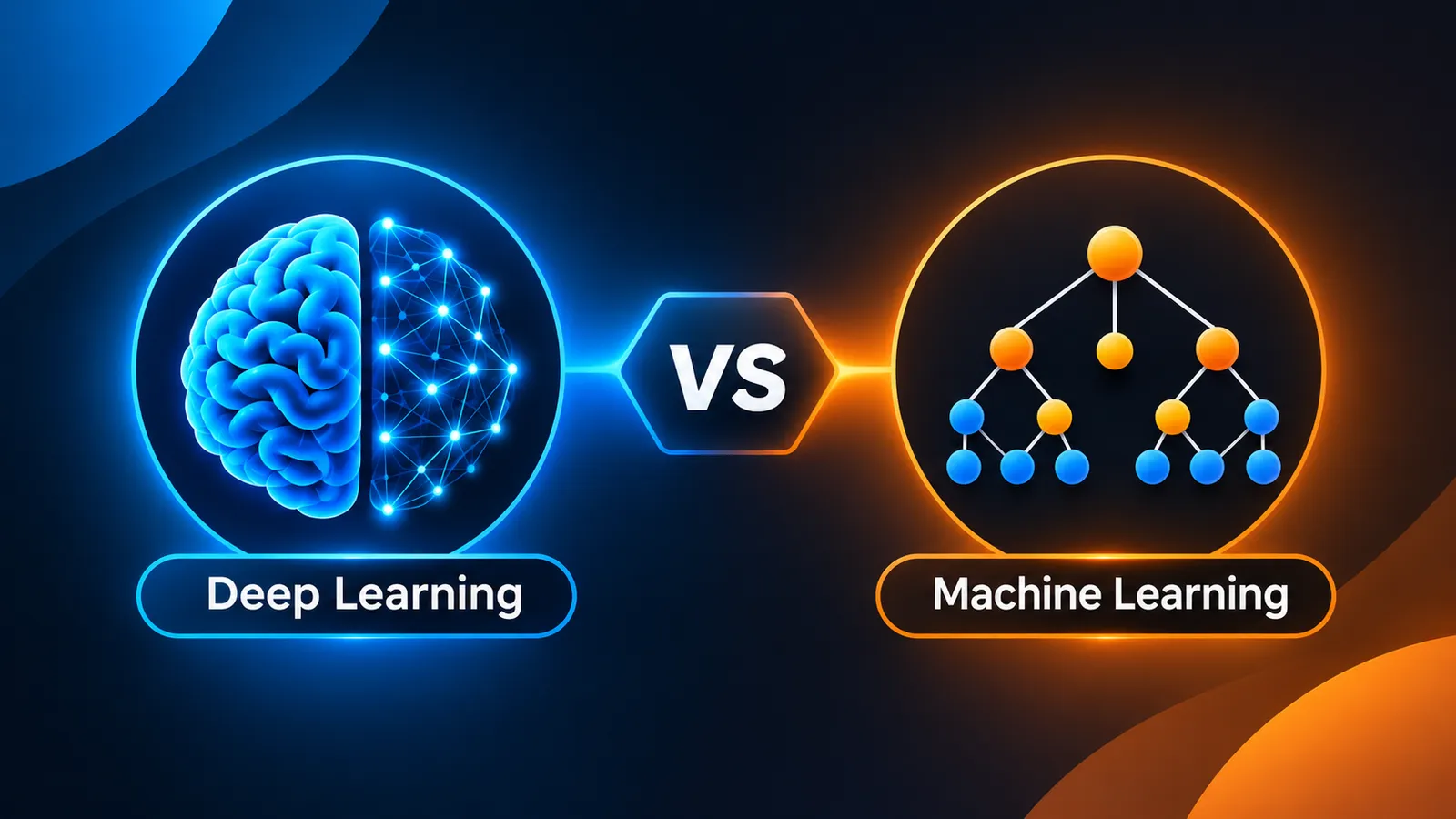
Machine Learning and Deep Learning. You may see the two terms used as synonyms, but they are not the same and work differently.
The two technologies provide computers with the ability to learn from data and facilitate decision-making with less human intervention. Yet, the manner in which computers analyze data and identify patterns is distinctly different.
Know the differences between Deep Learning and Machine Learning and how it can benefit your business.
What Is Machine Learning?
Machine Learning is a technology that makes it possible for systems to learn from previous data or experiences and make decisions accordingly. Instead of providing instructions for every possible condition, developers use it to train with examples.
Let’s say you look in your e-mail box. You may get some promotional e-mail, spam e-mail, and new business e-mail every day. E-mail filtering can learn from previous e-mails to identify which e-mails are most likely to be spam.
Machine Learning is similar. It scans data and finds trends, then uses those to make predictions.
But it still requires humans to tell the system what is relevant information for the task.
There are three common types of Machine Learning:
- Supervised Learning: This is one of the machine learning algorithms where it learns from labelled data. Eg it can learn the prices of previous houses and estimate the price of a new house.
- Unsupervised Learning: It requires unlabelled data and identifies the similarities or distinctions within data. Unsupervised Learning is used by businesses to analyze customer behaviour.
- Reinforcement Learning: This involves an iterative process whereby the system improves its current response by being rewarded with the right outcome and penalized for undesirable results. This type of learning is used mostly in robotics and gaming.
What Is Deep Learning?
Deep Learning is a more complex form of Machine Learning. It utilizes multiple layers of artificial neural networks to interpret information and to recognise patterns.
They loosely mimic the human brain. They are made up of interconnected layers of information, where each layer detects a different feature.
For instance, you could use facial recognition on your phone to unlock it. The algorithm will measure particular elements of your face and check to see if it matches any data stored to open the device.
Deep Learning methods are capable of doing this is that the most relevant features are learned from great data. The developers don’t have to figure out all the features by hand.
Some Common Deep Learning algorithms are:
- Convolutional Neural Networks (CNNs): Recognise objects, analyse photos, and medical images.
- Recurrent Neural Networks (RNNs): Are made to analyze sequential data, like speech and data through time.
- Transformers: A type of model in AI that is used in current-day applications like understanding and generating human speech.
- Generative Adversarial Networks (GAN’s): These are meant for generating compelling new images and other forms of digital content.
Key Differences Between Deep Learning and Machine Learning
While both fall under the domain of Artificial Intelligence, the two are different in approach.
Here are some key distinctions:
| Factors | Machine Learning | Deep Learning |
| Significance | A specific branch of Artificial Intelligence | A specific branch of Machine Learning |
| Data | Can work with a smaller dataset | Generally needs a larger dataset |
| Learning | Often requires manual feature selection | Learns feature automatically |
| Models | Uses algorithms such as decision trees | Uses a multi-layer neural network |
| Training | Usually takes less time | Can require longer time |
| Hardware | Often works on regular computers | Often benefits from powerful GPUs |
| Complexity | Suitable for many standard prediction tasks | Handles more complex data and patterns |
| Examples | Fraud detection and sales forecasting | Facial recognition and speech processing |
The most significant distinction is how these techniques have the ability to use information. Machine Learning frequently needs humans to choose the ideal features of data, whereas Deep Learning can often find those attributes on its own.
How Does Machine Learning Work?
Machine Learning follows a step-by-step process.
First, the developers gather data from sources including websites, customer records, business data, and applications. The data is then cleaned, and any inaccurate or irrelevant data is removed.
The data is then used to select and train an algorithm that is suitable for the problem at hand. The model is then trained on the data to learn the relationships between inputs and outputs.
After training, developers would then test the model to see if it could generate accurate results with fresh information.
Let’s say an online retailer employs Machine Learning; it can be used to recognize an individual customer’s shopping preferences. For example, if a consumer is used to shopping for physical training items, the site will suggest related products based on its purchase history.
So that merchants can assist customers better by providing better suggestions.
How Does Deep Learning Work?
Deep Learning is based on artificial neural networks, where there are multiple layers.
An input layer accepts data like a picture, video, or audio recording. The hidden layers analyze the data and discover different features in the data. The output layer gives you the output of what the deep learning model has learned.
The model matches the predictions with the real answers given. Once predictions are wrong, the model changes its settings for the next prediction.
Let’s say you create an app to view medical images; then a Deep Learning algorithm can go through thousands of medical scans and learn the pattern for a certain medical condition.
It helps the clinicians view the images and helps them to decide.
Real-World Applications of Machine Learning and Deep Learning
The two are employed in different industries; however, their uses vary as per the kind of information being used.
Where Machine Learning is used
1. Banking: Banks use Machine Learning to detect suspicious transactions as well as fraud.
2. Online Shopping: Shopping sites will recommend relevant items based on your interests.
3. Healthcare: It facilitates the analysis of patient data and the identification of potential threats.
4. Digital marketing: Marketing teams can analyze customer behaviour so that digital marketing campaigns can be optimized.
5. Business Management: Companies utilize predictive models for sales trends and predictions.
Applications of deep learning
1. Facial Recognition: On your phone or security system. Lidar: Gives information about the distance between environmental objects and the robot.
2. Self-driving cars: Helps us recognize vehicles, traffic signals, and various objects on the road.
3. Voice Assistants: Apps translate your words using Deep Learning.
4. Medical Imaging: Hospitals can utilise it to examine X-rays, MRI scans, and Medical Images.
5. Generative AI: Many tools that use AI now also make use of Deep Learning to produce text, images, sounds, and much more.
Which One Should Businesses Choose?
The distinction between the two is the end goal that the company is aiming for.
Machine Learning is the superior choice for a business that seeks to analyze customer data, identify sales trends, or spot outliers. It requires a minimum amount of data and consumes comparatively less computer processing power.
Deep Learning if you have project data such as pictures, videos, speech recordings or even text corpus then Deep Learning will be the option for you. It can identify some patterns that might not be found by Machine Learning.
Consider the retail business that hopes to predict its monthly sales. That might not be a candidate for a more sophisticated Deep Learning method. For the facial recognition app maker, Deep Learning might be the solution.
Before making the decision, you also need to consider your budget, available data, projects, and technical support.
Conclusion
Machine learning and deep learning have brought about a change in the way computer processing works. They are both components of artificial intelligence, although their roles differ. Machine learning is used for computation and analysis, while deep learning is responsible for complicated processes such as those involving speech, text, and images. Organizations can use them to enhance decision-making and create applications that suit their needs.
Frequently Asked Questions
1. What is the Difference Between Deep Learning and Machine Learning?
Ans: Machine Learning is an algorithm that provides data for you to learn from. Deep Learning is a neural network that has many layers where we can find patterns and analyze data.
2. Is Deep Learning more advanced than Machine Learning?
Ans: Deep Learning is only a branch of Machine Learning. You can do much more with Deep Learning, but it might not be necessary for all the use cases.
3. Does Deep Learning require more data?
Ans: Usually yes. Deep learning systems generally need a very large amount of training data to learn even just something simple, especially for video, speech, and image applications.
4. Can Machine Learning be used without Deep Learning?
Ans: Yes, a company can certainly do Machine Learning on their own – to do sales prediction, customer segmentation, identify fraud, or analyze data.
5. What is the top tech for AI?
Ans: It depends on the application: Machine Learning is good for several structured data problems; Deep Learning is good for more complex problems like image, speech, video, natural language, etc.